Textiles, certification, and care
What GOTS Certification Means in Naturepedic Organic Linen Bedding
A linen sheet begins in a field, but its story does not end when flax is harvested. Spinning, weaving, dyeing, finishing, and labeling all shape what eventually reaches a bed. GOTS certification is useful because it looks beyond the fiber itself—though, like any standard, it has a defined reach and is best understood by reading the details rather than treating the mark as a magic word.
The label is a beginning, not a complete biography
On a bedding label, “organic” may describe the source of a fiber. It does not necessarily explain what happened after that fiber left the farm. A crop can be grown to an organic standard and then enter a textile supply chain whose spinning, bleaching, dyeing, or finishing practices are not covered by the same claim. The word alone leaves a great deal unsaid.
The Global Organic Textile Standard, usually abbreviated to GOTS, was developed to address that gap. It is an international textile standard that applies to organic fibers and to important stages of processing and manufacture. In broad terms, it sets requirements for the organic content of covered textile products, restricts or controls many substances used in processing, and includes environmental and social criteria for certified operations. Its ambition is not merely to certify a plant in a field, but to follow an organic textile through a chain of production.
That distinction matters for bed linen. A sheet touches the skin for hours, is washed repeatedly, and is made through a sequence of industrial steps that can be difficult for a shopper to see. Certification offers a framework for asking better questions about those steps. It does not answer every question, and it does not turn a product into an environmental report card. But it provides more information than a bare claim about fiber content.
What GOTS is designed to cover
GOTS is a supply-chain standard. Its requirements apply to participating operations handling certified goods, including relevant stages such as processing, manufacturing, packaging, labeling, and trading. The exact route depends on the product and the businesses involved. Certified facilities are assessed against the standard, and documentation is used to support the movement of certified material through the chain.
There are two familiar levels of GOTS labeling: “organic” and “made with organic.” The distinction concerns the share of certified organic fiber in the product and the applicable labeling rules. Shoppers should not assume that every product carrying a GOTS reference contains precisely the same proportion of organic material. The product label and the standard’s current rules are the right places to check. For a particular item, the precise claim should be stated clearly and should be supported by certification documentation.
GOTS also addresses processing inputs. Rather than treating every chemical used in textile production as interchangeable, the standard sets restrictions and criteria for dyes, auxiliaries, and other substances used in processing. Environmental requirements can include controls related to wastewater treatment and resource management at covered processing units. Social criteria address conditions in certified workplaces, drawing on widely recognized principles concerning labor and worker protections.
These elements make GOTS more comprehensive than a fiber-only declaration. Still, “comprehensive” is not the same as “everything.” Certification applies within the standard’s scope, and its requirements may change as the standard is revised. A shopper seeking a particular assurance—about a dye, a factory, a farm practice, or an item’s country of manufacture—should look for that fact specifically rather than infer it from the certification name.
A closer look at linen
Linen is made from flax. Its surface is often irregular in a way that feels deliberate, though it is simply a consequence of the fiber and the cloth. Compared with many cotton fabrics, linen commonly has a more pronounced texture and a relaxed drape. It is valued for its ability to breathe and manage moisture, and it tends to soften with use. Those qualities explain its place in both warm-weather bedding and year-round linen wardrobes.
None of those tactile characteristics is created by certification. GOTS does not promise that a sheet will feel cool to every sleeper, wrinkle less, last a particular number of years, or become softer after a specified number of washes. These are matters of fiber, yarn, weave, finishing, construction, use, and care. Certification is about a set of production requirements and the integrity of the certified claim—not a standardized hand-feel test.
For linen bedding, then, it helps to separate several questions that are often bundled together. Is the fiber organic? Where was the flax grown? Where was the fabric woven and finished? Which stages and facilities are included in the certified chain? What is the fabric’s weight and construction? How should it be laundered? A single logo cannot replace these particulars, but it can give them a more meaningful context.
Naturepedic organic linen sheets as an example
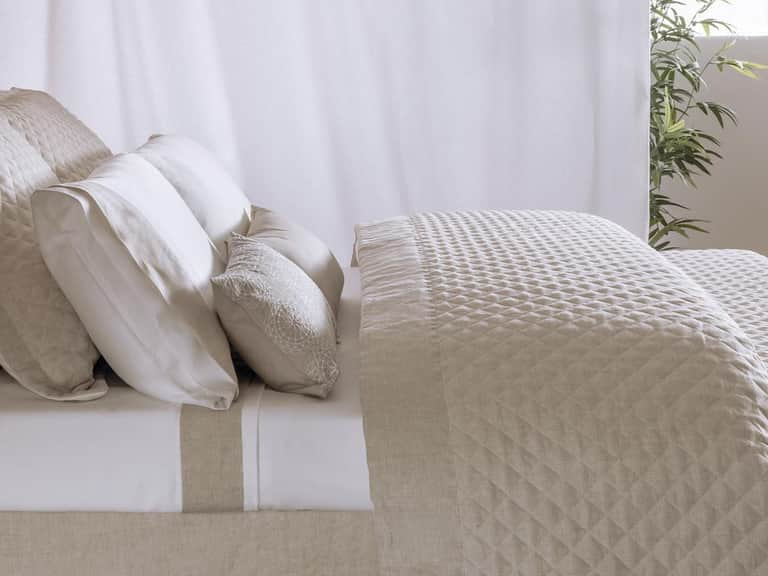
Naturepedic’s organic linen sheets provide a practical example of how to read a certification claim alongside a product description. The available specifications describe the sheets as GOTS-certified organic linen made from flax grown in France. They list a fabric weight of 185 grams per square metre and state that production takes place in India at a GOTS-certified organic facility. The set includes a flat sheet, a fitted sheet, and two pillowcases, with a 15-inch pocket on the fitted sheet.
Those details are useful because they do different jobs. “Flax grown in France” describes the stated origin of the raw material. “Made in India in a GOTS-certified organic facility” identifies a manufacturing location and a claim about the facility’s certification. “GOTS-certified organic” describes the product’s certification claim. They are related, but they are not interchangeable: growing origin is not the same thing as weaving location, and a facility’s certification is not, by itself, a complete account of every material or stage in a finished product.
For any textile, a careful shopper can look for the certification label, the product’s stated composition, and the name or code of the certifying body where provided. If important information is missing, the brand or retailer can be asked for clarification. In particular, it is reasonable to ask whether the finished product is certified under GOTS, what label grade applies, and whether certification documents cover the relevant supply-chain steps. A retailer’s product page is a helpful starting point, not a substitute for the underlying certification details.
Naturepedic’s stated care instructions are also part of the practical picture: machine wash warm, tumble dry low, warm iron, and do not bleach. These directions are product-specific. They should take precedence over general linen advice, which can vary from one fabric and finish to another. For linen sheets from other makers, follow the care label rather than borrowing instructions from a similar-looking set.
Readers can review the Naturepedic Organic Linen Sheets specifications alongside their own mattress dimensions and the full care information. The link is useful for understanding this particular item; it should not be taken as a claim that every linen product, or every product described as organic, follows the same route.
What certification does—and does not—tell you
Certification is often presented as a shortcut: one mark, many questions settled. A more reliable reading is narrower. GOTS can indicate that a textile product meets the standard’s requirements for organic fiber content and covered processing, environmental, and social criteria. It can make the supply chain more accountable by requiring certified businesses to meet defined rules and maintain records.
It does not mean that a product is entirely free of chemicals. Textiles are made through chemical and mechanical processes, and GOTS regulates the use of substances within its own criteria rather than eliminating every substance or process. Nor does certification establish that a sheet is hypoallergenic for every individual, medically beneficial, or suitable for a specific skin condition. Those claims require evidence beyond a textile certification.
GOTS also does not, on its own, guarantee a low carbon footprint, zero water use, local production, fair outcomes at every point beyond the standard’s scope, or exceptional durability. Organic agriculture and controlled processing can be meaningful parts of a more responsible production system, but no one certificate can summarize every environmental or social consequence. The distance a product travels, the energy used in manufacturing, how long it is kept, and how it is washed all belong to a larger conversation.
In other words, certification should be read as a defined assurance, not a universal endorsement. The careful question is not “Is this product perfect?” but “What does this standard verify, who verifies it, and what remains outside its scope?” That question is less dramatic than a green leaf on a hangtag, but considerably more useful.
A practical checklist for shopping
When comparing organic linen bedding, it helps to keep the label beside the details rather than letting either one stand alone. A few checks can make a product description easier to interpret:
- Confirm the claim. Look for a clear statement that identifies the product as GOTS-certified, not only a general reference to organic materials.
- Check the fiber content. Establish whether the item is 100% linen or a blend, and read the stated GOTS label grade and organic-content claim.
- Separate origin from manufacture. Note where the flax was grown and where the fiber was spun, woven, dyed, sewn, or finished, if those details are provided.
- Look for certification information. Where available, check the certifier’s name, certificate details, or other documentation that supports the finished-product claim.
- Read the construction and fit details. Fabric weight, weave, fitted-sheet pocket depth, and pillowcase dimensions affect use independently of certification.
- Follow the care label. Appropriate laundering can help preserve the textile, while overly hot drying, excess detergent, or bleach may undermine the fabric regardless of its certification.
This approach avoids a common confusion: treating ethical sourcing, comfort, and performance as if they were one property. They are connected, but distinct. A shopper may value all three and still need separate evidence for each.
Care is part of the textile’s life, not its certification
Linen bedding is frequently described as easy to live with, but “easy” is not the same as indestructible. The right routine depends on the maker’s instructions and on the fabric’s finish. Naturepedic’s stated directions allow warm machine washing and low tumble drying, while other organic linen products may specify cold water, a gentle cycle, or prompt removal from the dryer. These differences are not contradictions; they reflect different products.
As a general habit, avoid overcrowding the washer so that sheets can move freely and rinse properly. Use the recommended amount of detergent, and do not assume that more soap means a cleaner result. Residue can leave fabric feeling less pleasant. Bleach should be avoided when the label says not to use it, and a sheet should not be left damp in the machine for an extended period. If a particular care label gives different instructions, follow that label.
Repeated washing is part of bedding’s ordinary life. It is also where a fiber’s character becomes familiar: the softened hand, the creases that persist, the particular weight of a folded sheet. These are domestic observations, not certification claims. A well-made, well-cared-for sheet may remain in use for years, but GOTS does not guarantee a specific lifespan. Longevity depends on construction and handling as well as the circumstances of use.
The value of a precise claim
Textile labels have a difficult assignment. They must compress a complicated chain of farming, processing, manufacture, and transport into a small space, often beside a photograph of an immaculate bed. GOTS cannot make that chain simple. It can, however, provide a standard against which certain claims can be assessed and a structure for tracing certified material through participating businesses.
For Naturepedic organic linen bedding, the most useful reading combines the certification claim with the specifics: organic flax identified as grown in France, production described at a GOTS-certified facility in India, a stated fabric weight, sheet dimensions, and instructions for washing. Each fact has a boundary. Together they form a more informative picture than “organic” by itself.
The bed is a quiet place, but its textiles are the result of many decisions made far from it. Certification makes some of those decisions more legible. It cannot tell a shopper exactly how a sheet will feel on a warm night, or whether its texture will become a private favorite. It can help establish what kind of claim is being made—and what questions are still worth asking before the sheet is unfolded.